The New Hybrid Genres Are Just What The Music Industry Needs
For the longest time music was placed into pre-determined buckets that pretty much worked. Pop, Hip-Hop, Rock, EDM, Latin, Country, K-Pop, R&B/Soul, Indie/Alternative and Classical have been the buckets that dominated music all over the world. But if you drill down a bit, you see a host of hybrid genres that shows where the excitement really is.
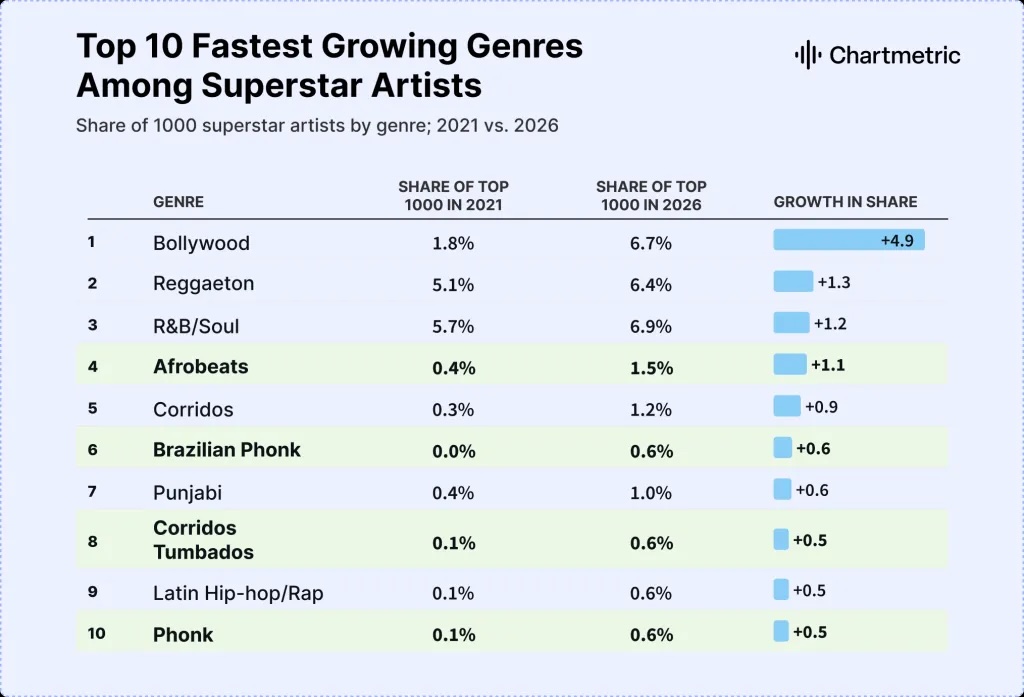
Fastest Growing
Just because a music genre can be considered legacy doesn’t necessarily mean that it’s growing. In fact, a new study by Chartmetric and Splice found that superstar artists are actually adopting less popular genres and sub-genres instead. These include:
- Bollywood
- Reggaeton
- R&B/ Soul
- Afrobeats
- Corridos
- Brazilian Phonk
- Punjabi
- Carridos Tumbados
- Latin Hip-Hop/Rap
- Phonk
Hybrid Genres
Probably what’s most exciting and may even wind up being transformational is when artists and producers mash up genres into a combination. When this happens we get something new, and occasionally, it can even result in a new trend. A great example of this is Hip-Hop, with music roots in Funk and Disco alongside a major cultural movement.
Examples of current popular hybrid genres include:
- Botanica
- Jerk
- Cloud Rap
- Brazilian Phonk
- Corridos Tumbados
- Afro House
- Pluggnb
- New Gaze
- Indietronica
- Rage
I’ll forgive you if you haven’t heard of many of these (I haven’t either), because these are what might be considered cutting-edge at the moment. They’re certainly not what the masses are exposed to, at least not yet.
As to how they are created, the article says it best. “. . . not every genre evolves through recombination alone. In some cases, artists take an existing sound and reshape it for a contemporary audience.
Cloud rap offers a particularly clear example. Originally emerging in the early 2010s through artists like Lil B, A$AP Rocky, and SpaceGhostPurrp, the genre was defined by hazy atmospheres, dreamlike production, and an internet-native aesthetic. More than a decade later, it’s seeing a resurgence: monthly searches for cloud rap on Splice grew 5.1x between 2023–2024 and 2025–2026, making it one of the platform’s fastest-rising genres. Yet the version returning today doesn’t sound quite the same. Artists like Fakemink and smokedope2016 have infused the genre with influences from newer online movements such as digicore and hexD, transforming what was once a distinctly 2010s sound into something new.”
The whole idea here is that fusing genres leads us to something new. As much as the industry tells us that we want what we already know (and it’s true), a sound that we’re somewhat familiar with that has a new twist may be just the thing that gets people excited all over again.
In a music industry that’s more and more automated and formulaic, that’s the only way it’s going to grow.